"He Rose. We Followed." — Il Casco Tributo di Alexander per Silverstone 2026
Di Lena Hoffmann
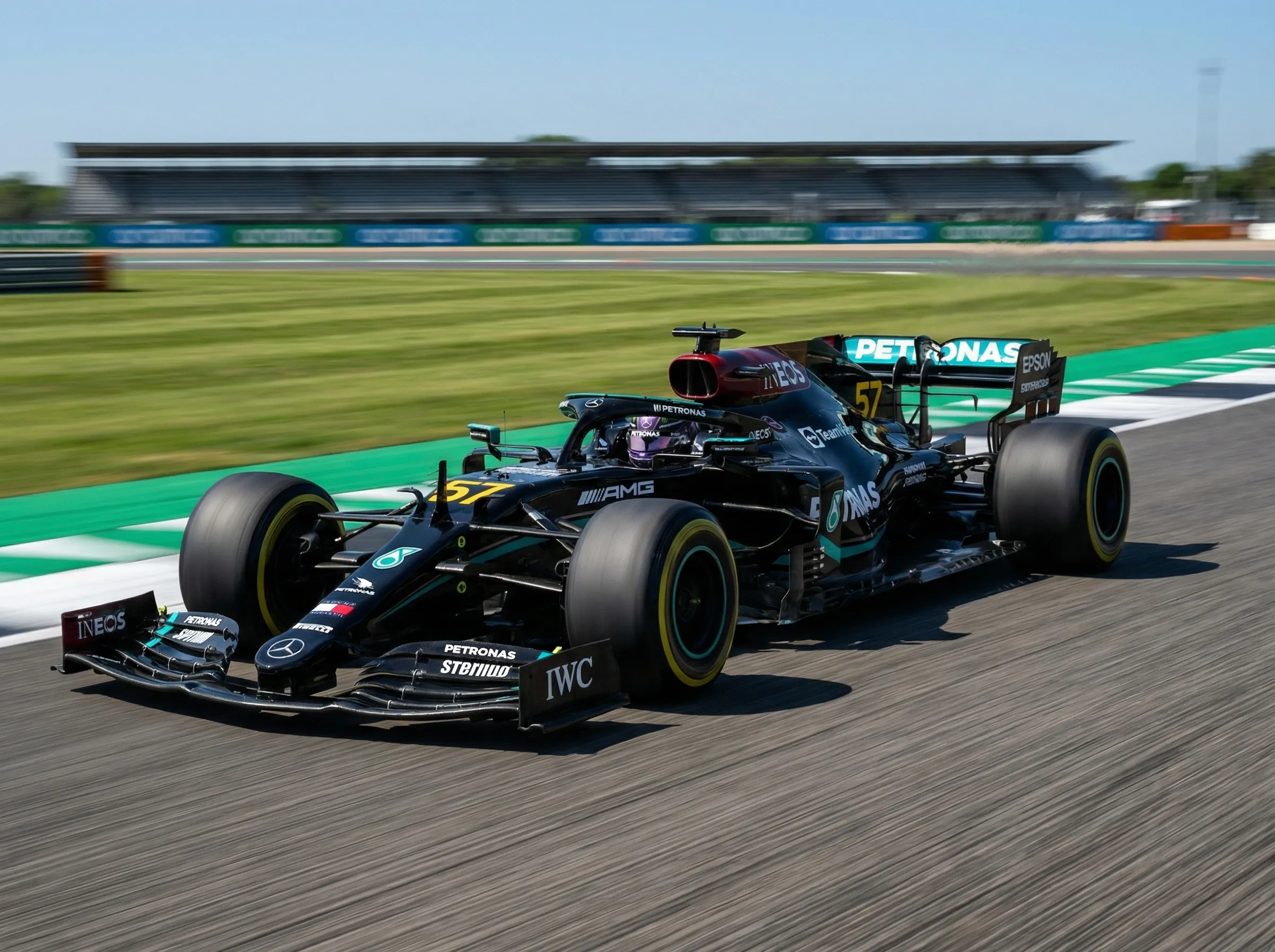
Every year, Alexander designs one special helmet. Those who follow his career know these aren’t marketing exercises or sponsor obligations—they’re personal statements, carefully considered tributes that reveal something about the man beneath the visor.
Monza 2021 honoured Ferrari’s colours. Barcelona 2022 paid homage to Fernando Alonso’s inspirational 2012 campaign. Silverstone 2023 was a quiet dedication to his parents, visible only to those who knew where to look. Austin 2024 celebrated the Texas family who had welcomed him as one of their own. Imola 2025 carried the handprints of children from a local hospital he’d visited during the winter.
For Silverstone 2026—his first British Grand Prix as a Mercedes driver—Alexander chose to honour someone still very much present in the paddock. Someone whose shadow falls long across the Brackley factory, whose records line the walls, whose presence shaped the very team Alexander now calls home.
Sir Lewis Hamilton.
The Design
The helmet features a deep purple-to-black gradient base, with swirling organic transitions between the tones—evoking the spirit of Hamilton’s iconic colour palette without directly replicating his angular geometric style. Under different light, the purple shifts and transforms, catching the eye the way Hamilton’s helmets always did.
Streaks of silver follow the helmet’s natural contours along the brow line, sweeping back from the visor, tracing the crown’s curve toward the rear. These accent lines honour Mercedes’ traditional silver identity while adding movement and dimension to the design.
On each chin guard sit three Mercedes three-pointed star roundels, six in total, marking Hamilton’s six World Championships won with the team between 2014 and 2020. Understated but unmistakable to anyone who knows their significance.
And on the rear, in clean silver lettering against the darker purple, four words:
He rose. We followed.
Why This, Why Now
“I’ve been asked why I would dedicate my home race helmet to a competitor,” Alexander said. “But that question misunderstands what Lewis represents—not just to me, but to an entire generation of drivers who came up watching him rewrite what was possible.”
Alexander was eleven years old when Hamilton won his first championship in 2008. He was working his way through the junior categories during Hamilton’s dominant Mercedes years, learning his craft while Hamilton was demonstrating his at the highest level.
“When you’re young and you’re trying to make it, you need proof that it can be done,” Alexander explained. “Lewis was that proof. Not just the driving—though the driving was extraordinary—but everything else. How he carried himself. How he used his platform. How he showed that a Formula 1 driver could be more than just someone who went fast.”
For Alexander, joining Mercedes meant inheriting something built over more than a decade. The engineering excellence, the culture of relentless improvement, the expectation of championship-level performance—all of it shaped by Hamilton’s presence.
“Walking into Brackley for the first time as their driver, you feel it immediately. His fingerprints are on everything. The standards he set, the way the team thinks about problems, the belief that they can overcome anything—that’s Lewis’s legacy. I’m not starting fresh. I’m continuing something he built.”
The Phrase
He rose. We followed.
The words sit in the same position where Hamilton places his own “Still I Rise” motto on his helmets. The parallel is deliberate. Not imitation, but acknowledgment. A response across generations.
“‘Still I Rise’ is Lewis’s phrase. It belongs to him, to his journey, to everything he overcame,” Alexander said. “But the response to someone rising is that others follow. That’s what I wanted to capture. Not just my story, but the story of everyone who watched Lewis prove what was possible and thought, ‘Maybe I can do that too.’”
It’s a sentiment that extends beyond racing. Hamilton’s impact on the sport—his advocacy, his visibility, his refusal to be diminished—opened doors that benefit drivers who may never fully understand what it cost to open them.
“Lewis changed what a Formula 1 driver could be,” Alexander said simply. “He changed who could see themselves in this sport. That’s bigger than any championship.”
Silverstone
The British Grand Prix holds particular significance this year. For Alexander, it represents his first British Grand Prix as a Mercedes driver, racing for the team Hamilton led to unprecedented success. All just 10 miles away from the historic British circuit which Hamilton himself holds the record for most victories. A staggering nine wins at home.
The two will be competitors on track, fighting for every position as they always do. But when Alexander’s helmet catches the light through Maggots and Becketts, it will carry a message that transcends competition.
Some things are bigger than rivalry. Some legacies deserve acknowledgment while we can still give it.
“I could have waited,” Alexander said. “Done this as a retrospective someday, after Lewis retired. But I didn’t want to. I wanted him to know now, while we’re both still racing, still fighting each other on track, that respect and competition aren’t opposites. That I can race him as hard as anyone and still be grateful for what he showed me.”
The helmet will be worn during all sessions of the 2026 British Grand Prix weekend, July 4-6.
He rose. We followed.
Questo anno, Alexander ha scelto di onorare qualcuno ancora molto presente nel paddock…
Ogni anno, Alexander disegna un casco speciale. Chi segue la sua carriera sa che non si tratta di esercizi di marketing o obblighi verso gli sponsor—sono dichiarazioni personali, omaggi attentamente ponderati che rivelano qualcosa dell’uomo sotto la visiera.
Monza 2021 ha onorato i colori della Ferrari. Barcellona 2022 ha reso omaggio all’ispirazionale campagna di Fernando Alonso nel 2012. Silverstone 2023 è stata una dedica silenziosa ai suoi genitori, visibile solo a chi sapeva dove guardare. Austin 2024 ha celebrato la famiglia texana che lo aveva accolto come uno di loro. Imola 2025 portava le impronte delle mani dei bambini di un ospedale locale che aveva visitato durante l’inverno.
Per Silverstone 2026—il suo primo Gran Premio di Gran Bretagna come pilota Mercedes—Alexander ha scelto di onorare qualcuno ancora molto presente nel paddock. Qualcuno la cui ombra si proietta lunga sulla fabbrica di Brackley, i cui record rivestono le pareti, la cui presenza ha plasmato il team stesso che Alexander ora chiama casa.
Sir Lewis Hamilton.
Il Design
Il casco presenta una base con un gradiente dal viola intenso al nero, con transizioni organiche e sinuose tra i toni—evocando lo spirito dell’iconica palette di colori di Hamilton senza replicare direttamente il suo stile geometrico angolare. Sotto luci diverse, il viola cambia e si trasforma, catturando lo sguardo nel modo in cui i caschi di Hamilton facevano sempre attraverso le curve di un giro veloce.
Striature d’argento seguono i contorni naturali del casco—lungo la linea delle sopracciglia, risalendo dalla visiera, tracciando la curva della calotta verso il retro. Queste linee decorative onorano la tradizionale identità argento della Mercedes, aggiungendo movimento e profondità al design.
Su ciascuna mentoniera si trovano tre tondi con la stella a tre punte Mercedes—sei in totale, che segnano i sei Campionati del Mondo vinti da Hamilton con il team tra il 2014 e il 2020. Discreti ma inconfondibili per chiunque ne conosca il significato.
E sul retro, in pulite lettere argentate sullo sfondo viola più scuro, quattro parole:
He rose. We followed.
Perché Questo, Perché Ora
“Mi è stato chiesto perché dedicare il casco della mia gara di casa a un concorrente,” ha detto Alexander. “Ma questa domanda fraintende ciò che Lewis rappresenta—non solo per me, ma per un’intera generazione di piloti cresciuti guardandolo riscrivere ciò che era possibile.”
Alexander aveva undici anni quando Hamilton vinse il suo primo campionato nel 2008. Stava facendo la sua strada attraverso le categorie giovanili durante gli anni dominanti di Hamilton in Mercedes, imparando il mestiere mentre Hamilton dimostrava il suo al massimo livello.
“Quando sei giovane e cerchi di farcela, hai bisogno della prova che si possa fare,” ha spiegato Alexander. “Lewis era quella prova. Non solo la guida—anche se la guida era straordinaria—ma tutto il resto. Come si comportava. Come usava la sua piattaforma. Come ha dimostrato che un pilota di Formula 1 poteva essere più di qualcuno che andava semplicemente veloce.”
Per Alexander, entrare in Mercedes significava ereditare qualcosa costruito in oltre un decennio. L’eccellenza ingegneristica, la cultura del miglioramento incessante, l’aspettativa di prestazioni da campionato—tutto plasmato dalla presenza di Hamilton.
“Entrando a Brackley per la prima volta come loro pilota, lo senti immediatamente. Le sue impronte digitali sono su tutto. Gli standard che ha fissato, il modo in cui il team affronta i problemi, la convinzione di poter superare qualsiasi cosa—questa è l’eredità di Lewis. Non sto ricominciando da zero. Sto continuando qualcosa che lui ha costruito.”
La Frase
He rose. We followed.
Le parole si trovano nella stessa posizione in cui Hamilton pone il suo motto “Still I Rise” sui suoi caschi. Il parallelo è deliberato—non imitazione, ma riconoscimento. Una risposta attraverso le generazioni.
“‘Still I Rise’ è la frase di Lewis. Appartiene a lui, al suo percorso, a tutto ciò che ha superato,” ha detto Alexander. “Ma la risposta a qualcuno che si eleva è che altri seguono. È quello che volevo catturare. Non solo la mia storia, ma la storia di tutti coloro che hanno guardato Lewis dimostrare ciò che era possibile e hanno pensato, ‘Forse posso farlo anch’io.’”
È un sentimento che va oltre le corse. L’impatto di Hamilton sullo sport—la sua advocacy, la sua visibilità, il suo rifiuto di essere sminuito—ha aperto porte che avvantaggiano piloti che forse non capiranno mai pienamente quanto è costato aprirle.
“Lewis ha cambiato cosa potesse essere un pilota di Formula 1,” ha detto semplicemente Alexander. “Ha cambiato chi potesse rivedersi in questo sport. Questo è più grande di qualsiasi campionato.”
Silverstone
Il Gran Premio di Gran Bretagna riveste un significato particolare quest’anno. Per Alexander, rappresenta il suo primo Gran Premio di Gran Bretagna come pilota Mercedes, correndo per il team che Hamilton ha guidato verso un successo senza precedenti. Il tutto a sole 10 miglia dallo storico circuito britannico dove lo stesso Hamilton detiene il record di maggior numero di vittorie. Ben nove vittorie in casa.
I due saranno rivali in pista, lottando per ogni posizione come fanno sempre. Ma quando il casco di Alexander catturerà la luce attraverso le curve Maggots e Becketts, porterà un messaggio che trascende la competizione.
Alcune cose sono più grandi della rivalità. Alcune eredità meritano di essere riconosciute finché possiamo ancora farlo.
“Avrei potuto aspettare,” ha detto Alexander. “Fare questo come retrospettiva un giorno, dopo il ritiro di Lewis. Ma non volevo. Volevo che lo sapesse ora, mentre corriamo entrambi, mentre ci combattiamo ancora in pista, che rispetto e competizione non sono opposti. Che posso gareggiare contro di lui con la stessa intensità di chiunque altro ed essere comunque grato per ciò che mi ha insegnato.”
Il casco sarà indossato durante tutte le sessioni del weekend del Gran Premio di Gran Bretagna 2026, dal 4 al 6 luglio.
He rose. We followed.